Extracting Design Guidelines for Wearables and Movement in Tabletop Role-Playing Games via a ...

summary
Research through design produces concrete tools and numbers: a 25-person participatory workshop, 15 preliminary Wizard-of-Oz and experience prototype tests, then 16 summative user tests. The team builds a 3D-printed Luck Stone, a sponge morph and a haptic gauntlet, plus a GM console and chance-manipulation rules; movement minigames alter dice probabilities. Results show wearables and embodied moments increase immersion and player–character bond, but require adaptable difficulty, reduced repetition, no screens and limited peripheral interaction — six actionable design guidelines for hybrid TTRPG mechanics.
AI-written summary · about
chapters (7)
- 0:00Introduction
- 1:43Inner RPG
- 2:35Example
- 4:13Design Process
- 6:36Distraction
- 8:16Repetition
- 9:30Interaction
related talks
 56mDesigners, Dungeons and Dragons
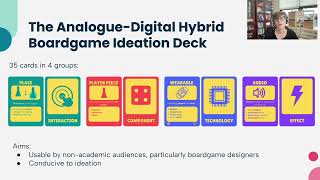 08mHow Boardgame Players Imagine Interacting With Technology
 23mPrototyping with Paper: How Board Games Become Reality
 08mIntro to Table Top Role Playing
 23mBuilding Better TTRPGs With Functional Thinking
 05mAuto-Paizo Games: Towards Understanding the Design of Games that Aim to Unify a Player’s Physical...
 19mFeelings and Videogames
 42mDesigning Engaging VR & AR Games