Drunk User Interfaces: Determining Blood Alcohol Level through Everyday Smartphone Tasks
summary
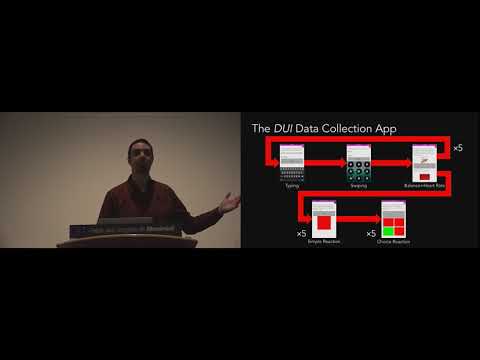
A smartphone system called the DUI app implements five tasks (typing, swiping a 3x3 passcode, PPG heart-rate hold, simple and choice reaction task) plus accelerometer/gyroscope features and trains a random-forest regression against breathalyzer readings. Evaluated on 14 people in a multi-day controlled study, it achieves a Pearson r = 0.96 and an absolute mean error of 0.005% ± 0.007%, with sensitivity 93.9% and specificity 82.3%, but it requires per-user calibration and quiet conditions to reach those numbers.
AI-written summary · about
chapters (12)
- 0:00Introduction to drunk user interfaces
- 1:49Motivation and project goals
- 3:56Related work and context
- 5:23Defining drunk user interfaces
- 6:26Task selection and design
- 9:36Typing and reaction tasks explained
- 11:45Study design and IRB challenges
- 14:37Initial study results and issues
- 16:23Multi-day study approach
- 17:47Calibration and evaluation methods
- 19:51Limitations and future work
- 20:42Q&A session