Memory Dialogue: Exploring Artefact-Based Memory Sharing

summary
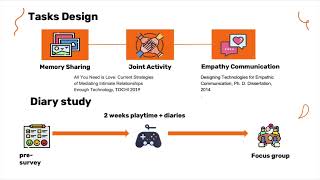
A study uses a seven-step memory dialogue method with 12 participants (six pairs) who each spend one week creating and then exchanging artifacts to represent a shared experience. Participants produce 15 artifacts (7 physical, 8 digital), favor bonding or transformation moments, and often keep perspectives separate — physical artifacts are diverse while digital ones are text-heavy; notably seven participants dismiss joint artifacts as problematic. The artifacts spark conversation and reveal mismatched effort and detail.
AI-written summary · about
chapters (9)
- 0:00Introduction
- 0:36Memory Dialogue
- 2:30Screening
- 3:24Methodology
- 4:48Themes
- 6:04Artifacts
- 7:55Joint Artifacts
- 8:19Emotional Judgement
- 10:33Questions
related talks
 03mChatterbox Opener: A Game to Support Healthy Communication and Relationships
 03mHumanizing Artifacts: An Educational Game For Cultural Heritage Artifacts and History Using Gener...
 16mMaking as Expression: Informing Design with People with Complex Communication Needs through Art ...
 08mVirtual Objects as Spatial Cues in Collaborative Mixed Reality Environments: How They Shape ...
 35mAdding Scaffolding to Collaboration for Deep Work
 19mShare and Share Alike? Social Information and Interaction Style in Coordination of Shared Use
 34mThe art of reflection
 24mCollaborative creativity