Sensing and Handling Engagement Dynamics in Human-Robot Interaction Involving Peripheral ...

summary
A robot implements a real-time engagement inference model that combines head-pose and other binary social-signal detectors to classify four states (S1–S4) and uses a 60s threshold to distinguish brief from prolonged disengagement. Two behavior policies are tested—explicit attention-grabbing and a subtler implicit wait—and a within-subject study with 27 participants shows robots using the model produce smoother conversation and better assistant performance, with the implicit strategy preferred as more polite and less annoying.
AI-written summary · about
chapters (6)
- 0:00Introduction to project
- 1:52Engagement states and transitions
- 6:27Behavior generation strategies
- 8:58User study setup and results
- 12:29Summary and future work
- 13:16Q&A session
related talks
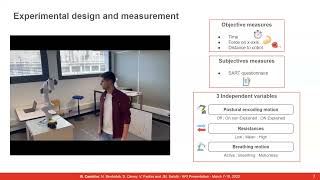 09mTask-Consistent Signaling Motions for Improved Understanding in Human-Robot Interaction and ...
 11mLearning Socially Appropriate Robo-waiter Behaviours through Real-time User Feedback
 28mPreference Learning from Minimal Human Feedback for Interactive
 10mExploring Machine-like Behaviors for a Socially Acceptable Robot Navigation in Elevators
 03mMaking good robots
 06mInterview with Jong Lee
 48mUses of Humanoid Robots in Large Public Spaces
 10mCognitively Assistive Robots at Home: HRI Design Patterns for Translational Science