CamRay: Camera Arrays To Support Remote Collaboration on Wall-Sized Displays
summary
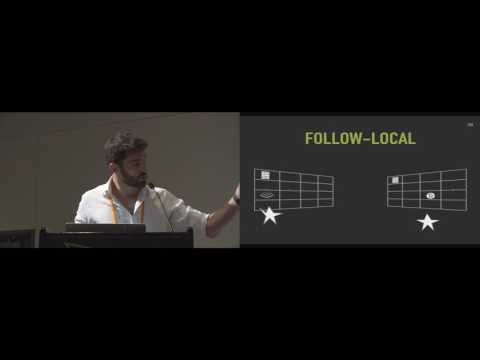
CamRay embeds camera arrays and Raspberry Pi nodes into wall-sized displays, uses infrared tracking and WebRTC with a cascading stream topology, and routes one selected face video per tile. Two behaviors are implemented: Follow-Remote (video follows remote user) and Follow-Local (video stays in front of local user). A controlled experiment shows 9.6% faster task completion for Follow-Remote versus Follow-Local and 8.2% versus side-by-side, with more deictic instructions, fewer errors, and tighter gaze/cursor alignment; some instructors still prefer Follow-Local for checking understanding.
AI-written summary · about
chapters (17)
- 0:00Start
- 2:51OBSERVATIONS FIRST PROTOTYPE
- 3:21OBSERVATIONS SECOND PROTOTYPE
- 4:17CAMRAY: A CAMERA ARRAY FOR TILED DISPLAYS
- 5:44HOW TO CAPTURE USERS?
- 6:16DEICTIC GESTURES
- 6:41FOLLOW-REMOTE
- 7:44FOLLOW-LOCAL
- 8:48STUDY 2 EXPERIMENT
- 10:10SIDE-BY-SIDE
- 10:23FACTOR LAYOUT
- 10:48TASK PERFORMANCE
- 11:13KINEMATIC ANALYSIS
- 12:52CONVERSATIONAL ANALYSIS
- 13:31QUALITATIVE FEEDBACK
- 14:21SUMMARY
- 15:40FUTURE WORK
related talks
 23mRemote Sketching
 17mTaskCam: Designing and Testing an Open Tool for Cultural Probes Studies
 21mMontage: A Video Prototyping System to Reduce Re-Shooting and Increase Re-Usability
 44mDesigning for Interactive Games
 07mBringing back human interaction to a digital world
 27mCollaborative, Remote, Design Working-Sessions
 28mVoices of Change | Panel Discussion
 01h 15mPre-sets and Post-sets: Poetics and Projections