Building a Personalized, Auto-Calibrating Eye Tracker from User Interactions
summary
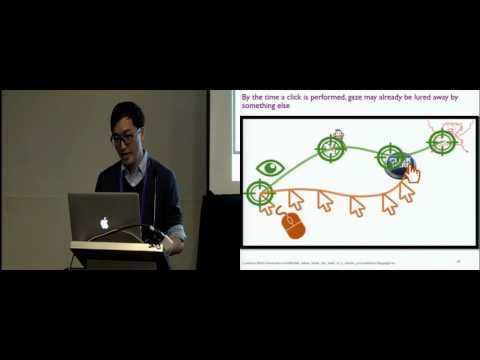
A webcam-based system called Personalized, Auto-Calibrating Eye Tracker (PACE) extracts geometric eye/facial features and uses a two-layer validation (behavior-informed temporal checks plus data-driven spatial filtering) to pick reliable training frames from ordinary mouse and key events. A random-forest gaze model trains on validated interaction moments (~1,050 good samples needed) and achieves ~2.56º average error on 31 subjects, outperforming a naive “look where you click” baseline and improving over time in an in-situ 10-user study.
AI-written summary · about
chapters (6)
- 0:00Introduction and motivation
- 3:05Challenges of webcam eye tracking
- 8:27Identifying gaze-interaction alignment
- 12:27Model performance and real-world testing
- 14:13Future work and limitations
- 15:16Q&A session
related talks
 21mSelf-Calibrating Head-Mounted Eye Trackers Using Egocentric Visual Saliency
 19mEyeScout: Active Eye Tracking for Position and Movement Independent Gaze Interaction with Large ...
 48mEye Tracking (a Deep Learning Approach)
 20mEye-tracking and AI: Unveiling the Limitations and Synergies
 19mEveryday Eye Contact Detection Using Unsupervised Gaze Target Discovery
 19mGazeProjector: Accurate Gaze Estimation and Seamless Gaze Interaction Across ...
 09mUsing Gaze Behavior and Head Orientation for Implicit Identification in Virtual Reality
 14mOddEyeCam: A Sensing Technique for Body-Centric Peephole Interaction using WFoV RGB and NFoV ...