Self-Calibrating Head-Mounted Eye Trackers Using Egocentric Visual Saliency

summary
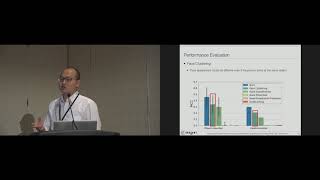
Shows a self-calibration pipeline that reduces calibration drift for head-mounted eye trackers by aligning eye-feature embeddings to predicted visual saliency maps and clustering those maps, using two bottom-up models plus face/person detectors. Evaluated on a new dataset of 20 users, one-hour recordings with synchronized video + EOG sensors, the method models drift as a 2D shift and applies a linear compensation; it measurably lowers drift and, given enough data, reaches gaze accuracy competitive with an explicit initial calibration.
AI-written summary · about
chapters (7)
- 0:00Introduction to calibration drift
- 1:30Problem of calibration drift
- 4:41Self-calibration pipeline overview
- 7:09Visual saliency approach
- 11:30Practical validation study
- 15:23Experimental results and findings
- 17:11Take-home message and Q&A
related talks
 20mBuilding a Personalized, Auto-Calibrating Eye Tracker from User Interactions
 19mEveryday Eye Contact Detection Using Unsupervised Gaze Target Discovery
 20mEye-tracking and AI: Unveiling the Limitations and Synergies
 48mEye Tracking (a Deep Learning Approach)
 09mUsing Gaze Behavior and Head Orientation for Implicit Identification in Virtual Reality
 19mEyeScout: Active Eye Tracking for Position and Movement Independent Gaze Interaction with Large ...
 17mEyeGrip: Detecting Targets in a Series of Uni-directional Moving Objects Using Optokinetic ...
 19mAggreGaze: Collective Estimation of Audience Attention on Public Displays