SHOCam: A 3D Orbiting Algorithm

summary
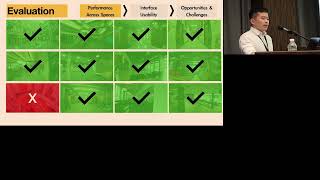
SHOCam is an orbiting algorithm that builds a strip of precomputed camera sets by walking the object surface toward closest features, interpolates positions with Catmull-Rom and orientations with slerp, and uses ray casting for closest-feature detection. It prevents camera penetration, smooths jitter that makes HarborCam stop on edges (HarborCam stops for ~30% of frames on some models), reduces closest-point computations and keeps frame rates comparable. A 14-participant study shows all but two users prefer SHOCam and it handles multi-object and multi-scale scenes.
AI-written summary · about
chapters (11)
- 0:00Introduction to SHOCam
- 1:28Problems with orbiting objects
- 3:35Limitations of HoverCam
- 5:23Introducing SHOCam solution
- 6:27Computing camera grid positions
- 8:55Interpolating camera paths
- 10:19Evaluating camera motion quality
- 12:49User study results
- 13:54Orbiting around multiple objects
- 15:42Scene hierarchy for orbiting
- 16:30Q&A session
related talks
 15mShot Orientation Controls for Interactive Cinematography with 360 Video
 41mComputer Vision for Remote AR
 27mHoloportation: Virtual 3D Teleportation in Real-time
 13mFlyMeThrough: Human-AI Collaborative 3D Indoor Mapping with Commodity Drones
 19mSynchronizAR: Instant Synchronization for Spontaneous and Spatial Collaborations in Augmented ...
 31mMerge Realities, Multiplay Wonder: Expert Guidance on Mixed Reality Development
 20mSuperiority of a Handheld Perspective-Coupled Display in Isomorphic Docking Performances
 19mCollision 2015 - Jens Christensen & John Underkoffler with Molly Wood