Procedural Modeling Using Autoencoder Networks

summary
Method builds a low‑dimensional control space by training autoencoders on procedurally generated samples that are selected by iterative categorization tree sampling and augmented with geometric descriptors (shape context, inner distance, light‑field). The decoder runs in real time so users manipulate only the autoencoder bottleneck to generate and interpolate models with barycentric weights; textures are handled via extra features. A 90‑participant study shows replication and design tasks complete >10x faster versus classic parameter UIs, and the authors plan to release training scripts.
AI-written summary · about
chapters (11)
- 0:00Introduction to talk
- 0:28Conventional procedural modeling
- 1:13Limitations of parameter space
- 2:40Autoencoder-based approach
- 3:22Categorization tree sampling
- 5:30Training the autoencoder
- 6:54Shape similarity features
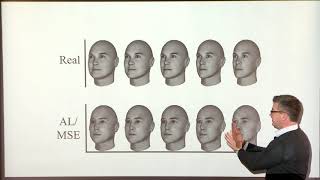
- 8:23Visual comparison results
- 9:26Interpolation for fine-tuning
- 10:29User study outcomes
- 11:11Conclusion and Q&A
related talks
 40mYou can AI like an Expert
 10mContinuous and Gradual Style Changes of Graphic Designs with Generative Model
 31mAuto-encoders in the wild... of telco land
 41mModels Schm-odels: Why you Should Care about Data-Centric AI
 30mTalk by Suhas Diggavi (UCLA)
 44mChoose the right neural generative model for your problem
 22mEfficient Pretraining of Text-to-Image Models
 52mPredictive Coding Models of Perception