Hidden in Plain Sight: an Exploration of a Visual Language for Near-Eye Out-of-Focus Displays in ...

summary
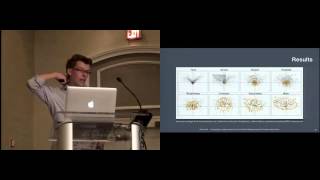
A wearable frame with two RoboPeak displays and an acrylic mount maps the usable peripheral area with a 10×10 grid and tests static and animated glyphs with 18 participants. Static shapes show low recognition unless users first learn a small, constrained set; motion reliably conveys animation type and path but rarely makes shape identity clearer; direct interaction supports precise linear movement and fill control, while rotation is hard. Conclusion: limit shapes, use orientation, meaningful motion and user control.
AI-written summary · about
chapters (10)
- 0:00Introduction to research
- 1:56Motivation for peripheral displays
- 4:04Previous work in peripheral visualization
- 5:27Study setup and methodology
- 7:56Exploring planar variables
- 9:21Static glyph recognition results
- 10:04Animated glyphs and path recognition
- 11:31User control and interaction precision
- 12:33Applications and next steps
- 14:16Q&A session
related talks
 20mPeripheral vision: a new killer app for smart glasses
 20mGravitySpot: Guiding Users in Front of Public Displays Using On-Screen Visual Cues
 20mOutside-In: Visualizing Out-of-Sight Regions-of-Interest in a 360 Video Using Spatial ...
 23m⚡️ FEDC 2018 - Ron Edelen
 34mThe eye of the beholder
 50mDesigning with animation
 39mCognitive Science and Design
 38mDesigning Spatial Apps for Apple Vision Pro