The Evolution of Engagements and Social Bonds During Child-Parent Co-design
summary
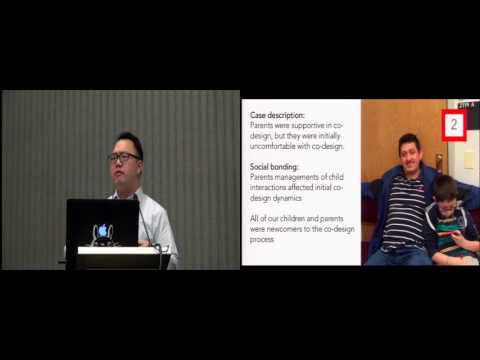
The study documents 14 families across nine sessions over ten months and finds parents’ engagement patterns shift much more slowly than children’s — children move from observation to design partners within a few sessions while parents often remain passive supporters until after sustained interaction. Separating adults and kids yields candid parent discussions; using low‑tech prototypes and layered elaboration on transparencies enables joint design once social bonds strengthen; reaching reliable parent co‑partnering consistently takes months, not single workshops.
AI-written summary · about
chapters (9)
- 0:00Introduction and motivation
- 2:37Modern families and co-design
- 6:12Study methodology and process
- 8:59Early co-design dynamics
- 10:02Evolving parent-child interactions
- 11:27Strengthening social bonds
- 12:50Collaborative design partnerships
- 14:15Implications and recommendations
- 15:57Conclusion and future work
related talks
 18mExamining Adult-Child Interactions in Intergenerational Participatory Design
 35mSlowing Down To Scale Design
 30mEmpathy is not enough - the power of engaging hard-to-reach users
 22mUsing Co-Design to Examine How Children Conceptualize Intelligent Interfaces
 24mTiny tots have thoughts too!
 41mThe Evolution of the Role of Designers | Francesco Vetica and Laura Camillucci
 20mCo-creation as a prototyping method
 14mCreating a Sociotechnical API: Designing City-Scale Community Engagement