Advanced Symmetric-Key Encryption
summary
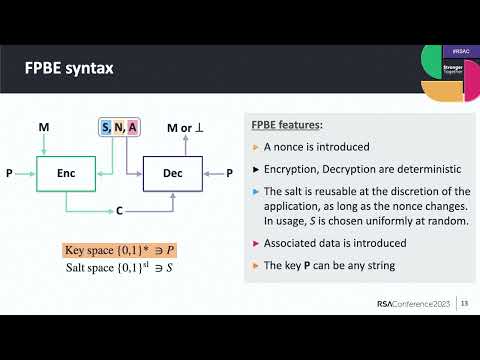
Proposes Flexible PBE (FPBE) and a concrete scheme called DtE that extends PKCS#5 to deterministic, nonce/AD-supporting, authenticated password encryption, proven in the random-oracle model; uses PBKDFs and standard ciphers (AES-GCM or key-robust variants) and claims provable resistance to partitioning-oracle attacks when key-robustness holds, giving tight concrete bounds that replace a large offline-guessing parameter qh with a small verification bound qv (often <3). For format-transforming encryption, introduces nested n-cycle walking, a practical deterministic method that avoids cycle-walking failures at modest ciphertext expansion.
AI-written summary · about
chapters (18)
- 0:00Intro
- 0:21Password-based encryption (PBE)
- 1:21Traditional PBE (TPBE)
- 3:52Our contributions: Flexible PBE (FPBE)
- 6:10Remarks and limitations
- 7:17FPBE syntax
- 8:08FPBE privacy
- 9:24FPBE authenticity
- 10:14FPBE authenticated encryption
- 11:28Motivation 1: Cloud storage
- 12:28End-to-End-secure PBE for cloud storage
- 14:02Motivation 2: Resisting partitioning-oracle attacks
- 16:44Security of DtE: Asymptotic results
- 17:32Guessing probability (GP)
- 24:31Format-Transforming Encryption (FTE)
- 27:49FTE Background: Ranking
- 33:28Building Deterministic FTE
- 40:53Nested n-cycle walking


