Build a modular Android app architecture

summary
Argues that modularizing yields concrete wins: using an AndroidX dependency-discovery plugin cuts a pre-summit build from about two hours to 10–20 minutes; choose between layered modules (Room, Retrofit, Moshi, Dagger) for fast isolation and testing or feature modules (Android App Bundle + Play Core dynamic delivery) for on‑demand code like Plaid’s DesignerNews and Dribbble; share common interfaces via a DataSourceProvider and ServiceLoader/reflection for runtime discovery; Room will later support merged multi‑module DBs; start layered, move to feature when team scale demands. Android App Bundle dynamic feature modules incremental CI
AI-written summary · about
chapters (15)
- 0:00Intro
- 1:17Faster incremental compilation
- 1:49Faster continuous integration
- 3:21Reduce install size
- 3:50Test different things
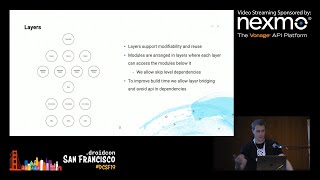
- 9:00Modularize per layer
- 10:01Bottomup approach
- 10:58Isolation
- 15:08Testing
- 16:14Dynamic feature modules
- 22:29Databases
- 23:13One database
- 25:01Hybrid approach
- 26:26Room
- 27:56Android free modules
related talks
 40mModularizing Android Applications
 27mModularising the right way
 35mArchitecture for App Bundles
 34mIntro to App Modularization
 45mArchitecture for AppBundles
 20mBreaking Down Modularization
 39mScaling an Android App from 1 to 100 developers with modularization.
 30mDynamic App Modules: Building For the Next Billion