Homomorphic Encryption

summary
A public-key variant of TFHE replaces bulky encryptions of zero with a convolution-based LWE ciphertext format, shrinking the public key from >500 KB to about 8 KB public key and reducing ciphertext noise by roughly two-bit noise gain, claimed secure under ring-LWE and supporting packed multiciphertexts for smart‑contract evaluation (FHEVM). A separate result explores using HE’s built‑in noise for differential privacy, finding potential privacy budget ~2 gains but showing approximate FHE not composable with DP because message‑dependent noise can leak and break security.
AI-written summary · about
chapters (8)
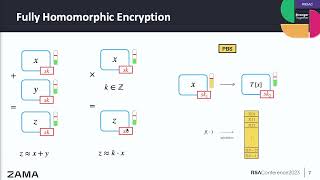
- 0:00Fully homomorphic encryption intro
- 5:02TFHE public-key encryption
- 13:20Bootstrapping and security
- 21:54TFHE public-key improvements
- 27:47Differential privacy with FHE
- 33:18FHE and DP challenges
- 39:33Q&A: Efficiency barriers
- 42:08Q&A: Noise protection
related talks
 54mFully Homomorphic Encryption
 01h 07mLattices and Encrypted Computation
 20mAugmenting EVMs with FHE to Enable New Use Cases
 23mBootstrapping Homomorphic Encryption via Functional Encryption
 52mMachine Learning over Encrypted Data with Fully Homomorphic Encryption
 38mPrivacy in the Open Source: Homomorphic Encryption
 45mFully Homomorphic Encryption I
 44mObfuscation III