Privacy in the Open Source: Homomorphic Encryption

summary
Demonstration compares open-source HE libraries and runs Python proofs of concept: TenSEAL and Pyfhel for tensor work, a legacy PySEAL wrapper and a PyFHE research library. Benchmarks show ciphertext addition approaching plaintext speed (24.9 μs vs 1.71 μs, ~15× slower) while multiplication remains costly (~3000× slower); an encrypted logistic regression on 4,000 rows runs orders of magnitude slower (about 350 seconds per epoch) but produces comparable accuracy. Repository contains Jupyter notebooks, timings, and notes on CKKS/BGV support and deployment tradeoffs.
AI-written summary · about
chapters (11)
- 0:00Privacy and homomorphic encryption
- 1:03Speaker and encryption basics
- 2:06Homomorphic encryption use cases
- 3:50Healthcare open source HE
- 7:44Advantages and limitations
- 9:29HE scheme types
- 13:08Open source HE tools
- 17:49Demo and research
- 22:44Logistic regression proof
- 26:39Frequently asked questions and comparisons
- 30:21Q&A implementation
related talks
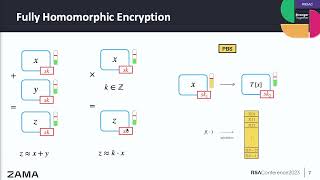 52mMachine Learning over Encrypted Data with Fully Homomorphic Encryption
 40mIt’s a Kind Of Magic: Computation on Ciphertexts
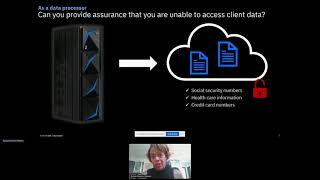 40mTrust No One
 47mHomomorphic Encryption
 33mThe Promise of Trustworthy AI
 20mDeep Dive into Privacy Enhancing Technologies
 44mIP Protection and Privacy in LLM: Leveraging Fully Homomorphic Encryption
 01h 07mLattices and Encrypted Computation