Trust No One

summary
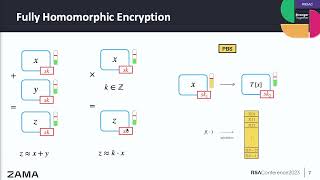
Claim: fully homomorphic encryption lets external services run ML and search while data never leaves ciphertext. Demonstration uses the IBM FHE toolkit (GitHub, Docker, runs on Linux and IBM Z), showing a privacy-preserving key-value search (country→capital) and an encrypted credit-card fraud model processed in 24 batches with client/server encrypted inputs and encrypted predictions. Code examples in C are included, performance is usable for analytics/ML workloads (not low-latency transactions), and the schemes are lattice based and quantum‑safe.
AI-written summary · about
chapters (9)
- 0:00Introduction and welcome
- 1:05Speaker background and mainframe focus
- 2:28Traditional encryption limitations
- 10:10Role-based data access risks
- 13:38Data privacy in cloud environments
- 15:24Fully homomorphic encryption explained
- 22:03FHE toolkit demo walkthrough
- 28:23Credit card fraud detection demo
- 30:52Q&A session
related talks
 52mMachine Learning over Encrypted Data with Fully Homomorphic Encryption
 44mIP Protection and Privacy in LLM: Leveraging Fully Homomorphic Encryption
 33mThe Promise of Trustworthy AI
 37mOpen-source Machine Learning on Encrypted Data
 40mConfidential Computing and Privacy-Enhancing Technologies - The Landscape
 26mUse case deep dive: Secure and privacy-preserving cyber threat intelligence exchange
 44mIntroduction to confidential computing – protecting sensitive workloads
 38mPrivacy in the Open Source: Homomorphic Encryption