Open-source Machine Learning on Encrypted Data

summary
Concrete ML compiles Python models to run under Fully Homomorphic Encryption so data stays encrypted end to end; it turns arbitrary functions into additions plus lookup tables, calibrates cryptographic parameters from a representative dataset, and demos include an image filter, sentiment classifier, and DNA-ancestry pipeline that run correctly. Practical limits: 16-bit lookup tables are viable, quantization is required, and runtime overhead is large—1,000 to 10,000× overhead—with ciphertext expansion from ~1000× reducible toward 10–20× via compression.
AI-written summary · about
chapters (13)
- 0:00Introduction
- 1:16Concrete ML and why it matters
- 5:30When to use confidential ML
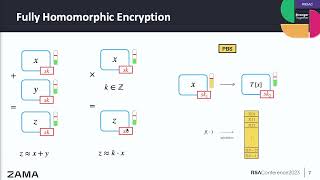
- 9:04Fully homomorphic encryption
- 11:06Compiler for encrypted computations
- 13:56Concrete ML framework
- 16:45Demo: encrypted image transform
- 19:54Demo: encrypted sentiment analysis
- 21:20Demo: secure DNA ancestry
- 23:52FHE for large language models
- 24:54Fine-tuning on encrypted data
- 26:19Open-source commitment
- 27:06Q&A
related talks
 52mMachine Learning over Encrypted Data with Fully Homomorphic Encryption
 40mTrust No One
 40mProtecting Sensitive Data and Models for Machine Learning
 01h 28mPPML: Machine Learning on Data you cannot see
 44mIP Protection and Privacy in LLM: Leveraging Fully Homomorphic Encryption
 44mPrivacy by Design Machine Learning
 33mHomomorphic Encryption in the Open Source World
 38mPersonal data de-identification for data science tasks