Structured Data in 2021 and Beyond

summary
Overview of concrete tools and results: RDF/OWL and SKOS power taxonomy and ontology work, PoolParty is used to manage taxonomies and spin up graph DBs, and Wikidata provides Wikidata Q identifiers to disambiguate entities across 400+ languages. Federated SPARQL queries join Wikidata and OpenStreetMap live, enabling things like ATM location maps without custom code. Knowledge graphs index entities (not strings) to improve search. NASA DataKnots and the Space Apps hackathon supply reusable open datasets for real projects.
AI-written summary · about
chapters (16)
- 0:00Start
- 0:11The Structured Data in 2021 Panel
- 4:16Aaron Lopez
- 5:31Is There a Consensus on What the Industry Means by Structured and Unstructured Data
- 11:25What's the Difference between Data and Content
- 11:51How Is the Data Persisted
- 15:10What Is Rdf and Owl
- 16:51Resource Description Framework
- 17:32Web Ontology Language
- 24:39What Does an Ontologist at a Startup Do
- 25:44What Is a Country
- 26:13How Do Historic Countries Relate to each Other
- 36:12Knowledge Graph
- 47:05Reading Level of Wikipedia
- 1:14:09Hardest Data Problems
- 1:21:15Session Evaluation
related talks
 39mEmphasising Relationships in the BBC's Data Using Technologies of the Semantic Web
 42mIntroduction to the Semantic Web
 05mUsing content from Wikidata in your apps
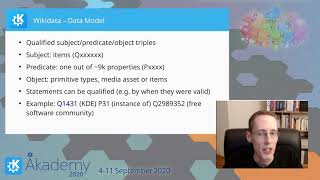 27mUsing Wikidata and OpenStreetMap
 10mOpen, Linked Data for a Global Community
 01h 05mThe Linked Data Revolution is Here, Are you Ready?
 51mBuild with Wikimedia Open Data: APIs, SPARQL and Visualization
 14mKnowledge Graphs for Locations in the Humanitarian and Development Sector