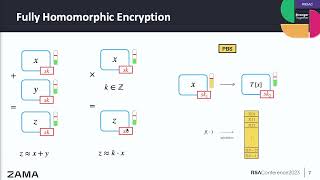
Fully Homomorphic Encryption

summary
Defines a leveled fully homomorphic scheme built from the learning with errors assumption that encodes messages as eigenvalues for a secret approximate eigenvector so ciphertexts are matrices whose S times C equals message times S G plus small noise. encryption uses A R + M G with a gadget matrix and G inverse to keep entries small and enable homomorphic NAND via C1 · G^{-1}(C2). noise multiplies roughly by n per level so after depth D it grows like n^D, and bootstrapping is required to get unbounded FHE.
AI-written summary · about
chapters (10)
- 0:00Intro
- 2:08Outsourcing Computation - Privately
- 3:27Fully Homomorphic Encryption (FHE)
- 11:11Approximate Eigenvector Method [GSW13]
- 20:23Learning with Errors (LWE) [RO5]
- 26:40Encryption Scheme from LWE
- 36:57Binary Decomposition Break each entry in C into its binary representation
- 38:58Approx. Eigenvector Encryption
- 50:10Homomorphic Circuit Evaluation
- 51:17Conclusion
related talks
 45mFully Homomorphic Encryption I
 23mBootstrapping Homomorphic Encryption via Functional Encryption
 01h 04mFully Homomorphic Encryption II
 01h 07mLattices and Encrypted Computation
 47mHomomorphic Encryption
 52mMachine Learning over Encrypted Data with Fully Homomorphic Encryption
 01h 01mMulti-key FHE and Spooky Encryption
 57mTutorial: Encrypted Computation from Lattices