Autonomous Hacking Systems - Future Risk or FUD?
summary
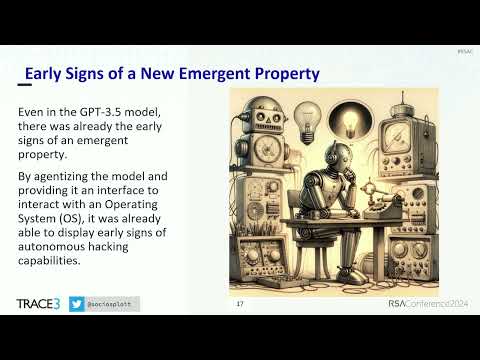
Claim: scaled LLMs can autonomously run live hacking campaigns. Built an automation loop that connected GPT-4 to OS (using PyAutoGUI to drive terminals), issued Nmap, installed redis-tools, used redis-cli, smbclient, SearchSploit and Metasploit, handled escaping quirks, and parsed outputs into compact “Lessons Learned” to stay inside context limits. On Hack The Box targets the system finds open ports, installs missing tools, and retrieves flags; prior research shows 73.3% exploitation success on web bugs. Nation-state adoption and runaway scaling are the main risk drivers.
AI-written summary · about
chapters (8)
- 0:00Autonomous hacking systems
- 3:40AI scaling and advancements
- 8:16Debunking AI FUD
- 11:52AI weaponization for hacking
- 18:43Live GPT-4 autonomous hacking
- 27:31Future risks and nation-state use
- 35:03Defensive strategies
- 38:40Q&A: AI vs AI detection
related talks
 29mBuilding a Hackbot: How Ethiack's Hackian Finds Real Vulnerabilities
 01h 24mOffensive Cybersecurity by AI Promises and Pitfalls
 13mThe Automation of Exploits: Will Eatherton on AI-Driven Security and the End of Obscurity
 39mHow to think like a hacker
 41mKeynote:Bend the Machine: The Hacker Path to Autonomy in the Real World
 33mAgentic ProbLLMs: Exploiting AI Computer-Use and Coding Agents
 55mHow hacking works
 20mAI Red Teaming and Automation: Exploring Societal Risks in...