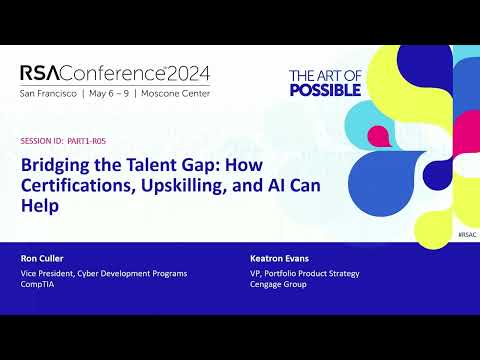
Bridging the Talent Gap: How Certifications, Upskilling, and AI Can Help
summary
Conference claims about a half million open cybersecurity roles and wider five‑million estimates drive a practical playbook: use vendor and vendor‑neutral certifications to map job skills, upskill adjacent staff (examples: turning Nessus operators into SOC analysts, an ultrasound tech into a security hire), remove degree barriers with skills‑based hiring and apprenticeships, and accelerate onboarding with generative AI workflows — including a malware analysis lab that found hidden indicators via prompting — plus tools like a job posting optimizer and techniques like retrieval-augmented generation and shadowing and apprenticeships to close the gap.
AI-written summary · about
chapters (13)
- 0:00Cybersecurity talent gap intro
- 1:54Cybersecurity job shortage reality
- 4:04Traditional job requirements barriers
- 7:15Certifications bridge skills gaps
- 13:47Skills-based learning over degrees
- 18:29Certifications validate real-world skills
- 20:19Upskilling internal talent for cyber roles
- 24:24Generative AI in cybersecurity learning
- 34:50Q&A on certifications and hiring
- 41:43Gamified cybersecurity training
- 44:12Education versus industry for cyber careers
- 48:24Federal hiring changes
- 50:34Closing remarks
related talks
 53mGapped Out: Unconventional Strategies for Addressing Cyber Talent Shortage
 50mKeynote: Closing the Security Talent Gap
 45mFuture-proofing Your Career in Cybersecurity
 40mUpskilling, Credentials and Soft Skills: Closing the Cyber Workforce Gap
 40mAnalyst View: How To Manage Info/Cybersec Careers in a Pandemic Recession
 37mBridging the Cybersecurity Skill Gap: Re-Thinking Job Profiles
 42mThe Technical Talent Market in 2025: Fortifying for AI, Cybersecurity, and Regulatory Compliance
 40mVisible Figures: Bridging the Skills Gap With Inclusion and Equal Opportunity