Illusory-UMH: A Systematic Comparison of Tactile Illusions and Modulation Techniques in Ultrasoni...
summary
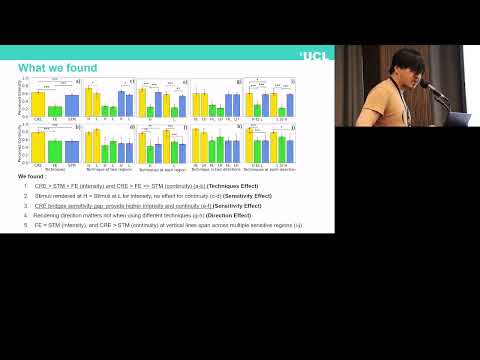
Compares Ultrasonic Mid‑Air Haptics (UMH) using focused acoustic focal points with three rendering methods—cutaneous rabbit effect, funneling effect and spatiotemporal modulation—on high‑ vs low‑sensitivity palm regions and two rendering directions; measures perceived continuity and intensity. Finds CRE yields significantly higher continuity and intensity than FE and STM in tested parameters, FE gives slightly better continuity across regions, STM produces higher raw intensity, CRE bridges high→low sensitivity gaps, and rendering direction shows no significant effect.
AI-written summary · about
chapters (8)
- 0:00Introduction and welcome
- 1:05Overview of mid-air haptics
- 3:08Tactile illusions and modulation techniques
- 4:52Study design and hypotheses
- 6:57Key findings and results
- 8:00Implications and applications
- 9:04Conclusion and future work
- 9:26Q&A session
related talks
 15mDirect Manipulation in Tactile Displays
 10mTowards Context-aware Automatic Haptic Effect Generation for Home Theatre Environments
 15mAugmenting Physical Buttons with Vibrotactile Feedback for Programmable Feels
 19mInvestigating Effects of Post-Selection Feedback for Acquiring Ultra-Small Targets on Touchscreen
 10mImpostor-based Rendering Acceleration for Virtual, Augmented, and Mixed Reality
 01h 03mFOUC, and the Death of Progressive Enhancement
 19mInteractive Volume Segmentation with Threshold Field Painting
 08mRelevance and Applicability of Hardware-independent Pointing Transfer Functions