Transforming Everyday Objects into Dynamic Interfaces using Smart Flat-Foldable Structures

summary
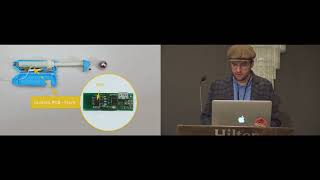
A thin, self-contained motion layer called Lemo attaches as an object's bottom surface and combines vibration motors and battery for energy with steerable modular legs driven by liquid crystal elastomer actuators heated by flexible resistive traces and monitored with a thermistor. Fabrication uses a flexible PCB and a Wi‑Fi microcontroller. A 12‑module layout produces six basic motions, follows four compound trajectories, moves up to 1.2 kg reliably, and lifts 800 g; actuation speed and load/area tradeoffs remain.
AI-written summary · about
chapters (8)
- 0:00Introduction and setup
- 1:16Project overview and motivation
- 2:21Lemo concept and design
- 4:07Fabrication process
- 6:52Application examples
- 8:18Evaluation results
- 10:05Conclusion and limitations
- 11:29Q&A session
related talks
 15mFlexiBend: Enabling Interactivity of Multi-Part, Deformable Fabrications Using ...
 17mLineFORM: Actuated Curve Interfaces for Display, Interaction, and Constraint
 16mKinetic Blocks: Actuated Constructive Assembly for Interaction and Display
 20muniMorph: Fabricating Thin Film Composites for Shape-Changing Interfaces
 23mMetamaterial Mechanisms
 14mHERMITS: Dynamically Reconfiguring the Interactivity of Self-propelled TUIs with Mechanical ...
 14mStrutModeling: A Low-Fidelity Construction Kit to Iteratively Model, Test, and Adapt 3D Objects
 23mFlexCase: Enhancing Mobile Interaction with a Flexible Sensing and Display Cover