GraspR: A Computational Model of Spatial User Preferences for Adaptive Grasp UI Design
summary
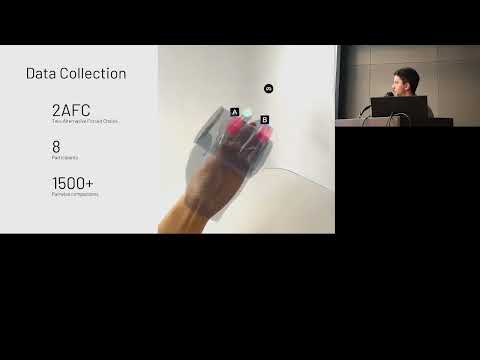
Computational model that predicts pairwise preferences for single‑finger microgestures, trained on 1,520 two‑alternative forced‑choice labels from eight participants and simulated 20,000+ fingertip positions spanning four common grasp types. Provides logistic regression and random forest baselines, runs a few minutes because of simulation, and outputs a spatial preference point cloud used to adapt UI layouts across four everyday tasks. Releases dataset and code, notes limits: small participant set and visual occlusion issues, points to EMG and direct geometry models.
AI-written summary · about
chapters (11)
- 0:00Introduction to GraspR
- 0:25What is GraspR
- 1:31Limitations of current approaches
- 2:35How GraspR works
- 3:18Demo with navigation app
- 4:41Adapting interface to objects
- 5:23Web UI and object shortcuts
- 5:44Training and data collection
- 7:29Model results and heuristics
- 8:10Limitations and future work
- 9:17Q&A and closing
related talks
 17mVR Grabbers: Ungrounded Haptic Retargeting for Precision Grabbing Tools
 20mIt's a Wrap: Mapping On-Skin Input to Off-Skin Displays
 43mThe Evolution of User Interfaces
 10mVirtual Object Categorisation Methods: Towards a Richer Understanding of Object Grasping for ...
 09mTangibleData: Interactive Data Visualization with Mid-Air Haptics
 43mDesigning for Hands, Gestures, and VR
 17mLearnings & Challenges for the Integration of Touchless Interaction
 05mHaptic PIVOT: On-Demand Handhelds in VR