Over-Threshold Multiparty Private Set Intersection for Collaborative...

summary
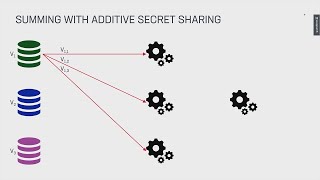
Protocol identifies IPs seen by at least t=3 parties using Shamir-style secret shares and a novel binning/hashing scheme that uses 20 hash tables sized proportional to each dataset and yields a 2^-40 failure probability. Complexity drops from an exponential-in-t search to roughly O(t^2 · M · binom(N,t)), enabling practical runs: median reconstruction time 170s, max under 420s on logs with up to 150,000 IPs per party and ~700 GB/day communication. Two deployments: collusion-safe (higher comms) and non-interactive with a non-colluding collector.
AI-written summary · about
chapters (10)
- 0:00Collaborative intrusion detection
- 1:43Sharing cybersecurity indicators
- 4:20Problem definition and goals
- 6:51Previous approaches limitations
- 7:32Secret sharing polynomial solution
- 9:19Finding matching secret shares
- 11:49Hashing for optimized matching
- 13:37Real-world experimental results
- 15:43Privacy-preserving detection results
- 16:48Open challenges future work
related talks
 27mMetadata-private data transfer
 01h 31mIntroduction to Secure Multi-Party Computation
 22mNext-Gen PeT: the Future of Multi-Party Computation Software
 35mMulti-Party Distributed Point Functions
 58mSecure Multiparty Computation I
 01h 10mSecure Multiparty Computation II
 01h 08mSecure Computation 1
 25mMCMix: Anonymous Messaging via Secure Multiparty Computation