In Link We Trust: BFT at the Speed of CFT using Switches

summary
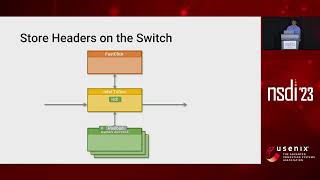
SwitchBFT implements a BFT consensus sequencer on P4 programmable switches, claiming BFT latency and throughput equal to CFT NOPaxos by using packet source authentication instead of signatures and a new primitive, verifiable unreliable atomic broadcast. The switch stores sequence numbers and digests, enforces recovery decisions with two bits per server, and tolerates switch crashes and packet loss. Evaluation on Intel servers shows parity with NOPaxos, negligible hash overhead up to 256 B, ~15% slower at the largest messages, and sustains peak throughput at 0.1% packet drop (≈20% drop only at high loss).
AI-written summary · about
chapters (9)
- 0:00BFT and state machine replication
- 3:35Trusted switches for BFT
- 5:01What programmable switches can and cannot do
- 6:26Switch BFT design and verification
- 8:15Unreliable atomic broadcast primitive
- 10:25Handling packet loss in BFT
- 12:55Implementation and optimizations
- 13:37Performance evaluation
- 15:49Conclusion and future
related talks
 15mAlea-BFT: Practical Asynchronous Byzantine Fault Tolerance
 17mThe Bedrock of Byzantine Fault Tolerance: A Unified Platform for BFT Protocols...
 23mBalancing on the Edge: Transport Affinity without Network State
 17mBFTBrain: Adaptive BFT Consensus with Reinforcement Learning
 01h 12mScaling distributed ledgers: Achieving arbitrary throughput and sub-second latency
 26mF10: A Fault-Tolerant Engineered Network
 17mMultitenant In-Network Acceleration with SwitchVM
 16mA High-Speed Stateful Packet Processing Approach for Tbps Programmable Switches