Next-Gen PeT: the Future of Multi-Party Computation Software

summary
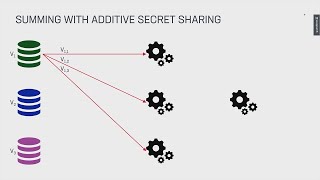
Shows how secret sharing and replicated sharing on three non‑colluding servers compute private operations (demonstrates 3 × 6 = 18 via share algebra) and how addition/multiplication compose to train or infer linear regression without revealing raw bank data. Notes real constraints: higher infrastructure cost, heavy communication overhead, need for cryptographic randomness, modular arithmetic subtleties, malicious-party protections and collusion risk. Recommends Meta’s CrypTen for experimentation but warns it’s not production‑secure.
AI-written summary · about
chapters (16)
- 0:00intro
- 0:20preamble
- 0:49security and privacy
- 1:52examples
- 5:42mpc in a nutshell
- 6:38secret sharing
- 7:45addition/substraction
- 9:58multiplication
- 14:24linear regression
- 15:02real (almost) case
- 16:34drawbacks
- 18:12closing thoughts
- 18:22security considerations
- 20:21crypten
- 20:51conclusions
- 21:35thank you!
related talks
 01h 31mIntroduction to Secure Multi-Party Computation
 37mBoF: PETs - Privacy-Enhancing Technologies Compared, Discussed &...
 37mPETs - A Technical Solution To Digital Sovereignty?
 11mCrypTen
 38mDemystifying Privacy Preserving Computing
 44mIntroduction to confidential computing – protecting sensitive workloads
 37mDemystifying Privacy Preserving Computing
 16mPrivacy Preserving AI