Demystifying Privacy Preserving Computing

summary
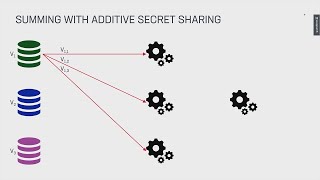
Covers federated learning with a simulated two-client example using the pift library (model parameters averaged back), differential privacy with noisy sums showing a true sum 368 vs noisy 363 on small samples, Shamir secret sharing for SMPC and its t+1 threshold, and homomorphic encryption demo adding 10 and 20 where encrypted addition runs about 1.6 million times slower. Shows code snippets, tradeoffs, and why HE and SMPC are still impractical at scale.
AI-written summary · about
chapters (14)
- 0:00🚀 Build Stuff Conference – Get Your Tickets!
- 0:40Introduction: The Importance of Privacy Preserving Computation
- 2:30Understanding Privacy and Security in Computing
- 5:00The Growing Need for Privacy Preservation in the Age of AI and Machine Learning
- 8:00Federated Learning: A Decentralized Approach to Machine Learning
- 12:30Example of Federated Learning and How it Works
- 15:00Introduction to Differential Privacy and How it Protects Your Data
- 18:00Code Example of Differential Privacy
- 20:00Secure Multiparty Computation: How Multiple Parties Can Collaborate While Protecting Privacy
- 23:30Understanding Homomorphic Encryption and Its Power for Private Data Processing
- 28:00The Challenges of Homomorphic Encryption and Its Future
- 31:30Practical Applications and Research in Privacy Preserving Computing
- 35:10How Future Techniques Might Solve the Challenges in Privacy and AI
- 36:37Conclusion: Balancing Privacy, Security, and Utility
related talks
 37mDemystifying Privacy Preserving Computing
 29mPrivacy-preserving methods: Building secure projects
 26mDoes using data mean giving up privacy?
 21m"SECRETS ARE LIES, SHARING IS CARING, PRIVACY IS THEFT." - A Dive into Privacy Preserving
 38mApplying Privacy-Enhancing Technologies
 01h 31mIntroduction to Secure Multi-Party Computation
 40mDemystifying Decentralized Fair Models for Federated Machine Learning
 01h 01mToward Provably Private Federated Learning