From substitutions to public keys - an introduction to cryptography

summary
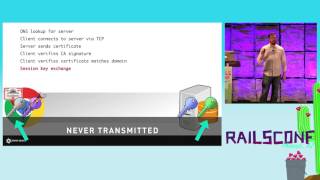
Covers hands‑on specifics: demonstrates Caesar shift and frequency analysis, explains AES internals with AES uses 16‑byte blocks and S‑boxes and 9/11/13 rounds, contrasts hashing and salting for password storage, and walks RSA math with RSA encrypts by c = m^e mod n showing private key d recovers m by c^d mod n; cites a 496‑bit example and RSA‑250’s 2,700 core‑years crack estimate, outlines TLS: certificate chain, MITM risk, session key exchange, and why asymmetric is used only to transport fast symmetric keys.
AI-written summary · about
chapters (10)
- 0:00Cryptography basics
- 4:46Caesar cipher to frequency analysis
- 8:02Zimmermann Telegram
- 13:00Hashing vs encryption
- 17:15Asymmetric encryption RSA
- 26:31Public key secures comms
- 31:54Certificate chains TLS
- 36:10MITM attacks defenses
- 42:30Root CA quantum threats
- 46:07Q&A
related talks
 42mCryptography, hashing, encryption without the math
 42mEverything I always wanted to know about crypto
 55mThe secrets of Cryptography
 58mKeynote: Crypto means Cryptography!
 52mAsymmetric Encryption: A Deep Dive
 40mAsymmetric Encryption: A Deep Dive
 41mBetter Than ROT13
 36mThe Art & Craft of Secrets: Using the Cryptographic Toolbox