Using Qt to develop games for Nokia devices
summary
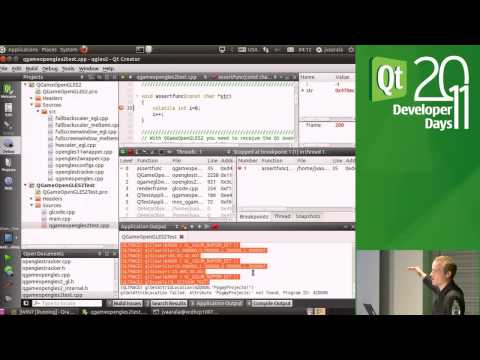
Shows a concrete toolchain and measurable tradeoffs: use QOpenGLES2 static library to manage GOOM, VBOs and texture shadowing and catch GL errors; use QGamePCM low‑latency audio or native devsound because QMediaPlayer gives ~500 ms latency while S^Anna can reach ~150 ms; expect big platform gaps (small bitmap blits are >100x slower than direct GL, OpenGL ES uploads are fastest) and tight memory (N8 exposes about 20 MB GPU texture budget), and a real port (Galaxy on Fire 2) runs on devices after a few days of integration.
AI-written summary · about
chapters (20)
- 0:00Introduction and background
- 1:54Qt for Symbian game development
- 3:19Nokia Qt-enabled platforms overview
- 4:23Qt Painter performance differences
- 6:54Optimizing small bitmap blitting
- 7:16Project file optimizations
- 8:22Qt audio limitations and solutions
- 11:12Multitouch hardware issues
- 13:18Symbian hardware architecture
- 16:33Graphics resource handling and GOOM
- 18:19OpenGL ES shader optimizations
- 20:26Finding performance bottlenecks
- 22:37Qt Game APIs and examples
- 23:22Native Games API solutions
- 29:23Low-latency audio API
- 31:07Qt OpenGL ES2 graphics API
- 39:13Debugging with Qt Game APIs
- 42:04Porting Galaxy on Fire 2 to Symbian
- 51:26Qt Game Enabler efficiency
- 54:20Q&A session
related talks
 06mMobile Game Development in Go
 36mCrafting Cross-Platform Adventures: Building a Game Engin…
 59mThe Horrors of Mobile Graphics
 48mIt's all Fun & Games on Android
 01h 00mHorrors of Mobile Graphics
 49mOptimising Graphics for Mobile Devices in Unity
 18mOvercoming latency, How we build a Cloud Game service with Go
 41mCRYENGINE