Milvus 2.0: Building the World's Most Advanced Open-source Vector Database
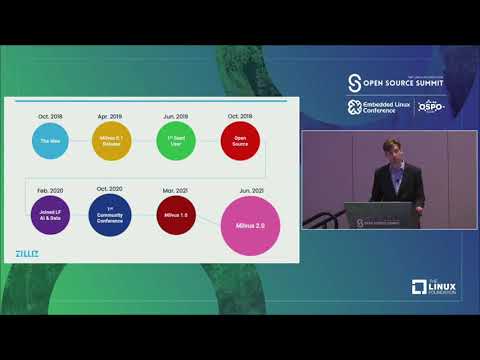
summary
Milvus 2.0 presents a Kubernetes-native vector database (deployed with Kubernetes native + Helm) that disaggregates storage and compute, uses Pulsar for a log backbone with ETCD metadata and MinIO/S3 storage, and implements Faiss/Annoy/HNSW indexes. It supports binary vectors (via RDKit for chemistry fingerprints) and claims dramatic wins: an 800M-molecule search drops from ~10 minutes on 30 nodes to 1,200× speedup (~0.5 s) on one node; Tokopedia reports 10× query speed, 90% hardware savings and 10× accuracy; Compass ships a production recommender in six months.
AI-written summary · about
chapters (15)
- 0:00Intro
- 1:25Unstructured Data
- 7:25ML Pipeline
- 12:04Milvus Architecture
- 13:09Access Layer
- 14:59Coordinator Layer
- 17:08Worker Layer
- 18:26Storage Layer
- 20:09Project Overview
- 20:34Users
- 21:16Smart Property Search
- 23:58Product Recommendation
- 25:33Pharmaceutical Molecular Analysis
- 27:53Reverse Image Search
- 30:16Music Recommendation
related talks
 30mMilvus Vector Database: Unlocking the Future of Open Source Vector Databases
 37mMilvus: Scaling Vector Data Solutions with Gen AI
- 37mMilvus: Scaling Vector Data Solutions with Gen AI
 29mThe Evolution of Milvus: A Cloud-Native Vector Database
 36mMilvus: Scaling Vector Data Solutions with Gen AI
 51mUnleashing the Potential of Cloud-Native Vector Databases
 26mThe Rise of Vector Databases - Lessons from the Milvus Community
 31mMilvus 2.0: A Vector Database With Cloud-Native Architecture