Enabling Low-Cost Secure Computing on Untrusted In-Memory Architectures
summary
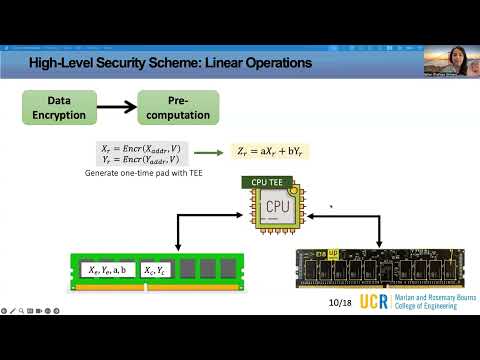
Uses arithmetic secret sharing and Yao's garbled circuits to split work between CPU TE and UPMEM PIM, with TE precomputation to avoid CPU bottlenecks. Implements lightweight integrity via MACs derived from a linear checksum on blocks. Evaluated on 20 UPMEM DIMMs (≈2,000 DPUs, 160 GB) across DLRM, MLP, and logistic regression, showing up to 14.66x speedup over a secure CPU baseline while keeping nonlinear operators on-PIM via garbled circuits.
AI-written summary · about
chapters (12)
- 0:00Secure computing on untrusted PIM
- 1:39Vulnerabilities in PIM
- 3:27Conventional memory encryption limits
- 5:41Workload balancing CPU vs PIM
- 7:55Prior secure PIM limitations
- 9:01Secure computation model for PIM
- 10:26Security scheme overview
- 12:39Nonlinear computations in PIM
- 14:05Computation integrity verification
- 15:13Evaluation setup and baselines
- 17:24Performance NLP and logistic regression
- 19:37Secure PIM acceleration benefits
related talks
 44mIntroduction to confidential computing – protecting sensitive workloads
 01h 31mIntroduction to Secure Multi-Party Computation
 14mScalable Memory Protection in the PENGLAI Enclave
 28mOblivious Multi-Party Machine Learning on Trusted Processors
 42mSponsored Session: Confidential Computing - New Capabilities for New Workloads
 01h 02mSecuring Embedded Hardware
 20mConfidential Computing within an AI Accelerator
 30mEncrypting Memory at Scale