MorphingCircuit: An Integrated Design, Simulation, and Fabrication Workflow for Self-morphing ...

summary
An end-to-end pipeline prints flat substrates, places standard SMT parts into sinks, screen-prints conductive traces, then triggers shape change by heating so circuits self-morph into complex 3D forms. A built FEA residual-stress simulator identifies “golden areas” for minimal trace-induced distortion, improving twist/bend/coiling outcomes. Fabrication uses screen-printed silver traces with oven or hot-water 4D activation (sputter coating optional); prototypes include a light-chasing three-leg robot, a touch/hover LED tree, tunable passive components, and a soil humidity sensor that all demonstrably work.
AI-written summary · about
related talks
 17mMorphSensor: A 3D Electronic Design Tool for Reforming Sensor Modules
 21mSilicone Devices: A Scalable DIY Approach for Fabricating Self-Contained Multi-Layered Soft ...
 20muniMorph: Fabricating Thin Film Composites for Shape-Changing Interfaces
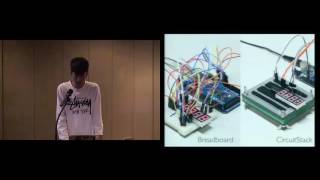 15mCircuitStack: Supporting Rapid Prototyping and Evolution of Electronic Circuits
 18mSoft Inkjet Circuits: Rapid Multi-Material Fabrication of Soft Circuits using a Commodity Inkjet ...
 20m4DMesh: 4D Printing Morphing Non-Developable Mesh Surfaces
 11mCapricate: A Fabrication Pipeline to Design and 3D Print Capacitive Touch Sensors ...
 19mAssembly-aware Design of Printable Electromechanical Devices