Leveraging Collaborative-Filtering for Personalized Behavior Modeling: A Case Study of ...

summary
A memory-based collaborative-filtering method personalizes depression detection by building a relevance matrix from passively sensed features and using the squared Pearson correlation to weight similar users. It selects stable features per epoch, imputes labels from weighted neighbors, and combines per-feature binary outputs with majority-vote per feature to classify mild-or-worse depression. Evaluated on two datasets (CMU and UW, ~100 first-year students each, ~40% depressed), it beats prior state-of-the-art by +5.1% accuracy / +5.5% F1 on CMU and about +3.4% average on the second dataset.
AI-written summary · about
chapters (10)
- 0:00Intro
- 0:34Depression and Mobile Sensing
- 0:51One-size-fits-all
- 1:33Collaborative-Filtering
- 2:19Behavior Profile
- 2:49Personalized Collaborative Filtering
- 3:37Datasets
- 4:04Model Performance
- 4:42Personalized Interpretation
- 5:25Summary
related talks
 28mCan we measure depression
 32mAnalyzing social media for suicide risk using natural language processing
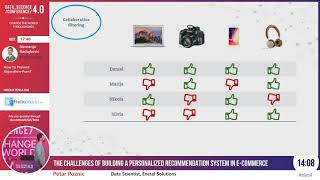 29mThe Challenges of Building a Personalized Recommendation System in E-Commerce
 18mMultimodal Classification of Moderated Online Pro-Eating Disorder Content
 37mA primer on recommendation systems.
 20mAugmenting Mental Health Care in the Digital Age: Machine Learning as a Therapist Assistant
 43mBuilding your first recommender
 06mPredicting Subjective Measures of Social Anxiety from Sparsely Collected Mobile Sensor Data