How to Hack a Painting

summary
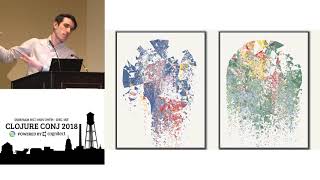
Details matter: a concrete generative model simulates watercolor with the Processing framework and Clojure (Quil), deforming polygon edges by three variables (start, angle, magnitude) sampled from a Gaussian distribution, recursing ~six times and compositing about 50 layers of low‑opacity variants with inherited variance. Seeds are saved for exact re‑renders, outputs are TIFF prints, renders range from fractions of a second to about a minute, and the program consistently produces convincing watercolor‑like textures and usable finished pieces.
AI-written summary · about
chapters (22)
- 0:00Introduction
- 2:40Recent work
- 7:45Goals
- 10:45Watercolor Characteristics
- 12:42ExpansionDeformation
- 14:27Gaussian Distribution
- 16:57Soft Edges
- 18:52Processing Issues
- 19:42Modeling Edges
- 20:47Soft Transitions
- 21:40Deformation
- 23:27Color Blending
- 24:57Final Thoughts
- 27:55Questions
- 33:58Rendering
- 34:58Drawing by hand
- 35:54Other distributions
- 37:01Other artists
- 38:29How long does it take
- 39:47Audio synthesis
- 40:42Randomness
- 41:53Geometry
related talks
 32mCode goes in, Art comes out
 37mCreative Coding for Fun and (Non)Profit
 22mCreating Immersive Generative Art With Go
 25mPainting with Code
 27mCreating Immersive Generative Art with Go
 22mGenerative Art Speedrun
 27mRecreate Masterpieces of Modern Art with Javascript
 26mRecreate Masterpieces of Modern Art with JavaScript!