Wildcat: Educational RISC-V Microprocessors
summary
An open-source RISC-V core implemented in Scala/Chisel shows concrete measurements: three-stage pipeline runs faster and uses fewer FPGA resources than four- or five-stage versions on Intel and AMD Xilinx FPGAs and in a SkyWater130 ASIC synthesis, because the wide forwarding multiplexer critical path in longer pipelines limits fmax. A single-cycle prototype even synthesizes to ~7 MHz on an FPGA; a tiny ASIC tapeout (~0.22 mm², register file ~55% of core area) boots a hardcoded hello world LED.
AI-written summary · about
chapters (8)
- 0:00Motivation for Wildcat
- 0:42Analysis of existing cores
- 1:41Wildcat design philosophy
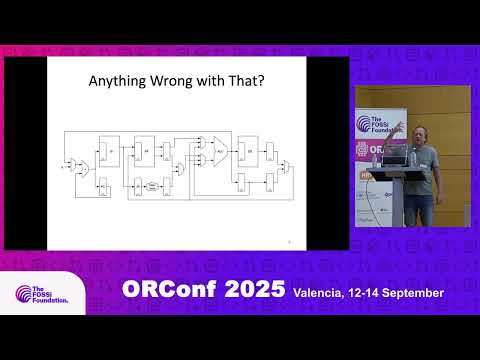
- 2:38Critique of five-stage design
- 5:06Advantages of three stages
- 6:15Synthesis and results
- 9:00Project summary and origins
- 10:21Q&A and discussion
related talks
 18mRISC-V Performance Delivered
 11mRISC-V Spotlight: How RISC-V Speeds the Journey of Innovation
 08mSERV: RISC-V for a Fistful of Gates
 37mWhy go RISC-V-y?
 43mRISC-V CPU Project in Western Digital
 15mRISC-V processor IP product line
 13mDemo: RISC-V as an Enabler of Heterogeneous Compute
 01h 01mThe Genius of the RISC-V Microprocessor