Cosmos DB for MongoDB: Choosing the right architecture Q&A
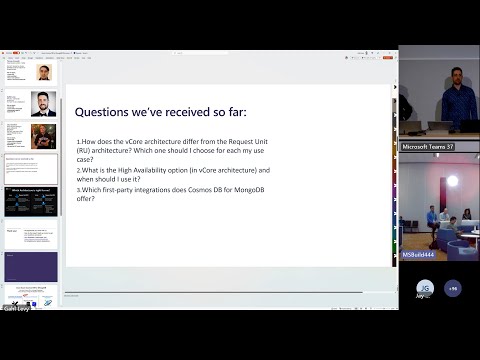
summary
Q&A contrasts two deployment choices: request unit (RU) architecture (cloud‑native, instant scaling, multi‑region writes, 99.999% availability, Mongo API now supports 16 MB docs after prior 2 MB limit) versus vCore architecture (VM‑style sizing, HA replicas option, easier 1:1 migrations, better for long running aggregations and heavy analytics). Serverless, autoscale and provisioned RU models remain; vCore currently exposes MongoDB 5.0 while RU supports up to 4.2. New vector indexing and Synapse Link integrations support embeddings and near‑real‑time analytics.
AI-written summary · about
chapters (16)
- 0:00Introduction
- 3:25Q&A
- 4:09Cosmos DB vs MongoDB Atlas
- 9:32Migrating legacy MongoDB
- 12:41Cosmos DB for projects
- 15:57MongoDB features and APIs
- 16:19RU vs Vcore architectures
- 20:52Microservices use cases
- 22:47Partitioning recommendations
- 25:15Querying with Synapse
- 27:24Vector indexing for AI
- 28:56Power BI integration
- 31:56High availability in Vcore
- 33:42Consistency levels
- 35:36High availability in RU
- 38:34Closing remarks
related talks
 32mAzure Cosmos DB Performance Tuning
 01h 00mAzure Cosmos DB : A brief Note for Developers
 50mDeploying #MongoDB on public clouds: Architecture and options
 19mRelational or Non-Relational? Choosing the Best Database for the Task
 53mManaging enterprise JSON workloads with Amazon DocumentDB
 01mInvitation – Patty Chow
 33mDriver for Data-Driven Change - Azure Cosmos DB Performance, Security & Cost Optimization Done Right
 54mSay Yes to NoSQL for the .NET SQL Developer