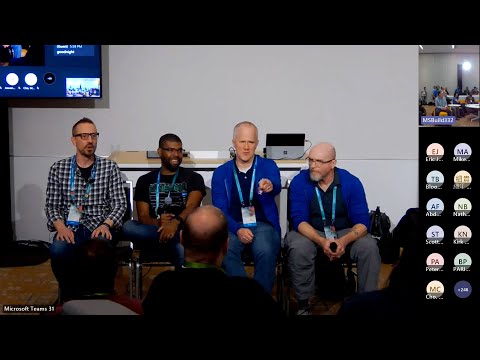
ASP.NET Core and Blazor futures Q&A
summary
Roadmap detail: Blazor expands in .NET 8 with static server rendering, WebAssembly improvements and Native AOT support; migration uses the Net Upgrade Assistant plus YARP proxy for incremental moves; tooling surfaces runtime-like routes in Visual Studio via Endpoints Explorer (design-time heuristics vs runtime API Explorer). Blazor WASM can shrink to about ~1 MB with relinking but AOT trades faster execution for larger downloads. GitHub shows ~38 “good first issue” labels and a runtime lab prototype explores green threads with prototype performance within roughly twofold of baseline.
AI-written summary · about
chapters (15)
- 0:00Welcome
- 1:18Blazor vs ASP.NET Web Forms
- 5:35Contributing to ASP.NET Core
- 8:27Migrating from MVC5 to ASP.NET Core
- 11:20Choosing .NET version for migration
- 16:17.NET Standard role
- 18:28Blazor for low-bandwidth needs
- 20:18Speeding up Blazor WebAssembly
- 22:45Blazor WebAssembly AOT
- 26:15API Explorer vs OpenAPI
- 29:47Blazor vs Razor Pages future
- 35:25Blazor vs JavaScript frameworks
- 38:38Blazor and GPU processing
- 40:04Green threads in .NET
- 45:03Closing remarks
related talks
 01h 14mThe Future of Web Development with ASP.NET Core & Blazor in .NET 10
 01h 15mWhat's Next for ASP.NET Core & Blazor
 01h 01mWhat’s next for Blazor, and .NET on WASI
 46m.NET: What's Blazor - Front .NET
 01h 01mBlazor, a new framework for browser-based .NET apps
 01h 00mASP.NET Blazor programming 101
 47mBlazor - Next Generation UI with .NET 6
 59mThe future of Web: what Microsoft Blazor can do for you