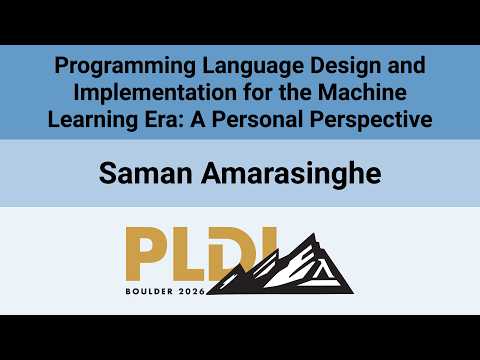
Programming Language Design and Implementation for the Machine Learning Era: A Personal(…)
summary
Machine learning actually changes compiler work in three concrete ways: ML augments heuristics (the 2003 Meta Optimization effort evolves priority functions and yields ~25% speedups on general programs and ~50% on training sets), ML trains better cost models (Item I trains on 1.4M basic blocks and produces a cost model about 2x more accurate than prior tools), and ML can generate compilers or proofs (a verified Fortran subset compiler emits 40,000 lines in 34 days with machine‑written proofs; VIGEN/GoSLP/VIMAL learn vectorization and often match or exceed hand‑built code).
AI-written summary · about
chapters (20)
- 0:00Introduction
- 2:32Keynote opening
- 3:13Talk structure
- 4:36ML in compilers history
- 6:24Machine learning augmenting traditional compilers
- 8:52Building a vectorizer using machine learning
- 11:39Imitation learning beats cost models
- 13:22Cost models for hardware
- 16:31Compilers from manuals
- 19:44Compilers with proofs
- 23:16Can ML replace compilers
- 25:52Machine learning transforming programming workflows
- 28:45Why languages matter
- 31:15LLM-oriented IRs
- 34:29Future source of record
- 38:39Bidirectional LLM compilation
- 41:30Languages for ML era
- 43:58Plea for ML compiler research
- 49:35Future tools and action
- 51:05Q&A
related talks
 34mOptimizing AI Inference with ML Compilers & Hardware
 27mImproving Vectorization Heuristics in a Dynamic Compiler with Machine Learning Models
 59mPrinciples of Programming Language Translators
 32mTaming the Machine: Basics of ML Models Training and Inference Optimization
 43mMachine Learning for Developer Productivity
 01h 53mMachine Learning for Manycore System Design and Optimization
 44mMachine Learning for Faster Optimization
 01h 00mBetter Learning through Programming Languages