Progressive Web Apps

summary
Claims that Progressive Web Apps shrink install friction and bandwidth: a service worker acts as a scriptable proxy to cache and refresh assets, a JSON manifest makes a site installable, and HTTPS is required. Tools shown include Workbox, Mozilla’s ServiceWorker Cookbook, Lighthouse and PWABuilder which generates manifests and service workers. Concrete results: an open‑source expense PWA works offline and installs on desktop and mobile, and Twitter’s PWA uses roughly one tenth the data of the native build.
AI-written summary · about
chapters (18)
- 0:00Progressive Web Apps Covering the best of both works
- 0:54Chris Heilmann @codepo8
- 4:50Progressive Web Apps are not...
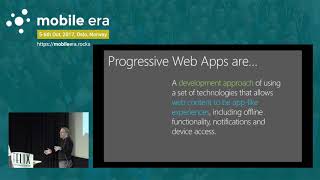
- 7:16Progressive Web Apps are...
- 14:14The Web of old isn't fun...
- 16:34Making it look better didn't help
- 18:56Mobile apps are good, but need love
- 23:46POSITIVES (Web)
- 25:26NEGATIVES (Web)
- 27:05POSITIVES (Native)
- 27:53NEGATIVES (Native) Huge data footprint with non-atomic updates
- 33:05On Windows: Store & Bing
- 36:16Service Worker Cookbook (Mozilla)
- 36:48Google Workbox
- 38:45Google Lighthouse
- 40:07What the web can do today
- 40:52PWA Stats by Cloud Four
- 42:10The link as distribution model
related talks
 46mKeynote: Progressive Web Apps
 49mIntro To Progressive Web Apps
 37mIntro to Progressive Web Apps
 46mProgressive Web Apps with the Service Worker API
 38mProgressive Web Applications: The What, the Why and the How
 43mProgressive Web Apps - the Return of the Web?
 16mRevolutionize Your User Experience with Progressive Web Apps
 10mAny Site can be a Progressive Web App