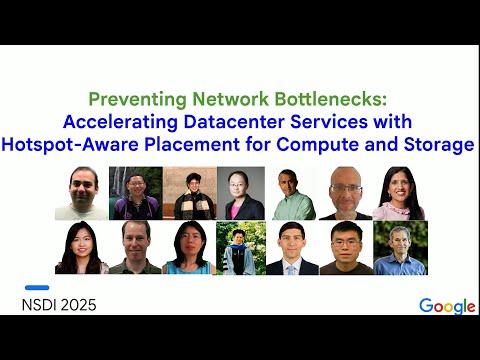
Preventing Network Bottlenecks: Accelerating Datacenter Services with Hotspot-Aware...
summary
Analysis of Google datacenter ToR hotspots shows links that persist hot for hours and often exceed 75–90% utilization, causing over 2× end-to-end latency for some services. Root causes are bandwidth demand–supply imbalance and placement that ignores network capacity. Practical fixes add network-awareness to Borg scheduling and Colossus placement: avoid placing or migrate network‑heavy tasks away from hot ToRs and place data under ToRs with available bandwidth, yielding 90% fewer hot ToRs and p95 latency down 50% in deployed clusters.
AI-written summary · about
chapters (9)
- 0:00Network hotspots in datacenters
- 1:41Why hotspots occur
- 5:35Hotspots on storage systems
- 7:19Quantifying hotspot effects
- 9:48Hotspot sensitivity in queries
- 11:52Network-aware scheduling
- 13:44Hotspot-aware placement in Borg
- 15:11Summary and future work
- 17:16Q&A
related talks
 12mBreaking the Transience-Equilibrium Nexus: A New Approach to Datacenter Packet Transport
 18mMeasuring Congestion in High Performance Datacenter Interconnects
 17mNetHint: White-Box Networking for Multi-Tenant Data Centers
 31mTuning Linux TCP for data-center networks
 16mOptimizing Network Provisioning through Cooperation
 29m"Datacenter Infrastructure Innovation"
 18mArchitecting Multi-tenant Data-center Networks for GPU Customers
 14mRDC: Energy-Efficient Data Center Network Congestion Relief with Topological