PAPAYA Federated Analytics Stack: Engineering Privacy, Scalability and Practicality
summary
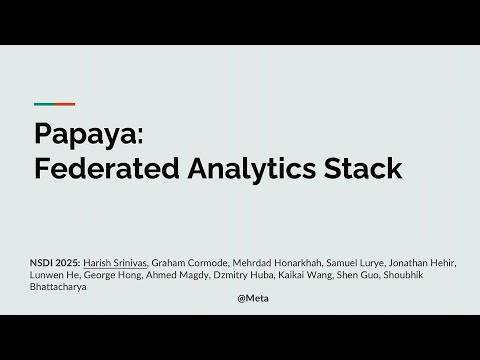
PAPAYA is Meta’s federated analytics stack that combines trusted execution environments with on-device, SQL-based transformations and hard-coded client guardrails to enable ad hoc SQL queries while enforcing privacy. Clients send sparse histograms batched to amortize setup cost; a TEE-based aggregator sums reports and applies central or hybrid differential privacy. The system achieves about 90% coverage in 24 hours, near-ground-truth accuracy under central DP, and predictable server load.
AI-written summary · about
chapters (14)
- 0:00Federated analytics intro
- 2:06Federated analytics challenges
- 3:52Analytics vs learning
- 4:56Trusted execution environments
- 6:03Cross-device design
- 8:11SQL computations
- 9:56Client runtime & privacy
- 11:02Secure aggregator
- 12:46Privacy guarantees
- 13:31Scalability & control
- 14:35Evaluation metrics
- 15:16Speed & coverage
- 16:41Noise impact on accuracy
- 17:02Conclusion
related talks
 26mAnalytics & Data Science with Privacy at its Core
 14mEstablishing Privacy Metrics for Genomic Data Analysis
 10mData Access Automation at Scale
 45mMaking Privacy Technology Accessible: Benchmarks and Platforms
 27mPrivacy-preserving statistical analyses
 14mToward Provably Private Insights into AI Use
 20mBuilding Privacy-First Healthcare AI Platforms
 24mPETAce - Using Applied Cryptography to Enhance Privacy