Learning Cooperative Personalized Policies from Gaze Data
summary
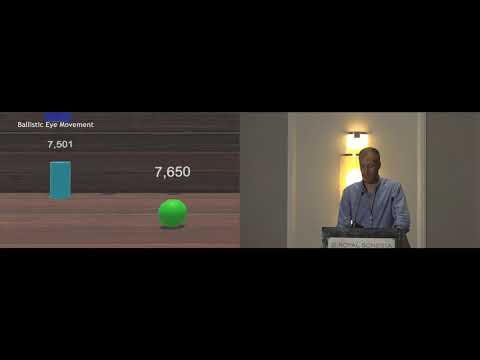
Proposes a model-free reinforcement learning agent trained on replayed gaze trajectories (14 participants, 1,300 trials) that decides per-object whether to show or hide labels based on fixation angle, gaze velocity and a discrete show/hide action set. Trains with a reward that punishes clutter and missed-needed labels, compares to an SVM baseline, reduces displayed information by 87% while improving support in a visual search, and generalizes to supermarket and toy-plane scenes. SVM baseline 14 participants
AI-written summary · about
chapters (15)
- 0:00Introduction to talk
- 0:26Mixed reality label challenges
- 1:32Personalized labeling policies
- 4:05Reinforcement learning approach
- 5:10Data collection study
- 6:56Semi-Markov decision process
- 8:00State and action space
- 8:45Reward function design
- 9:48Training reinforcement learning
- 10:29Comparison with supervised baseline
- 11:50User study results
- 13:15Conclusion and limitations
- 14:38Limitations and future work
- 15:02Summary of contributions
- 15:47Q&A session
related talks
 09mThe Subconscious Director: Dynamically Personalizing Videos Using Gaze Data
 28mPreference Learning from Minimal Human Feedback for Interactive
 42mLearning Representations for Visual Search
 17mRECL: Responsive Resource-Efficient Continuous Learning for Video Analytics
 38mWhere are we looking? Predicting human gaze using deep networks.
 23mLearning with Limited Labels & Weak Supervision
 10mMIND MELD: Personalized Meta-Learning for Robot-Centric Imitation Learning
 19mWhat Can Be Predicted from Six Seconds of Driver Glances?