The Toy-SRAM Project

summary
An open-source multiport memory system replaces bespoke register-file circuits with a replicated 10T SRAM cell that separates reads and writes, enabling lower voltage operation (~0.4 V), higher speed and easy port scaling by replication. A working prototype targets 64 registers × 24 bits, uses three nonstandard cells in a mainly standard-cell wrapper, aims for double-data-rate/dual-clock operation to get two reads per half-cycle, and is planned for fab-friendly 130 nm 5LM silicon.
AI-written summary · about
chapters (5)
- 0:00Start
- 3:57Features of TOY-SRAM
- 8:43What is specific bandwidth? Why does Toy-SRAM do so well?
- 18:22Plans for TOY-SRAM
- 19:12Toy-SRAM key components
related talks
 30mEnabling Big Memory workloads to run
 18mOpen Source computer architecture research at the BSC
 18mOpen source chip design: for fun and for profit
 30mUnleashing Innovation from Core to the Edge
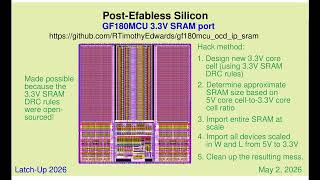 19mPost-Efabless Silicon on SkyWater, GlobalFoundries, and IHP
 10mKeynote: The Open Source Hardware Roadmap
 18mPicoRio: An Open-Source, RISC-V Small-Board Computer To Elevate The RISC-V Software Ecosystem
 19mErbium SOC, Architecture, Design and Verification