Rust: A Friendly Introduction

summary
Claim: Rust gives zero-cost abstractions and memory safety without paying a runtime GC tax by combining ownership and borrow checker rules, explicit pointer kinds (owned, managed, borrowed, raw) and LLVM-backed codegen. Examples include Servo prototype browser work and a NES emulator with real trait-based interfaces; microbenchmarks approach C speed. Tools shown: rustc, macros, unit test and benchmark harnesses; project has 100+ contributors and targets Linux, Mac, Windows and Android.
AI-written summary · about
chapters (31)
- 0:00Start
- 1:23Systems Programming
- 3:00Well-typed programs don't go wrong
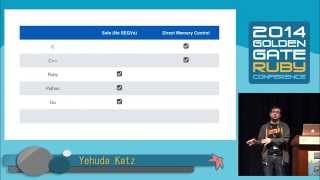
- 5:03with memory safety
- 5:29without runtime cost
- 7:16Roadmap
- 9:44Statements and expressions
- 15:38Pointers and mutability
- 16:33Enumerations
- 17:37Matching on enumeration
- 18:41Nonsense cases
- 19:17Non-exhaustive matches
- 20:02Enums can have fields
- 21:10Checking for Null
- 21:47Destructuring in Rust
- 23:08Pattern-matching and vectors
- 24:03Structs
- 25:37Struct example
- 26:08Closures
- 26:57Loops
- 30:06Methods
- 31:26Generics
- 31:57Generic types: example
- 32:24Generic functions
- 35:33Interfaces
- 37:23Types can have traits
- 38:17Trait example
- 38:53Trait bounds
- 39:55Implementation example
- 42:28Static vs. dynamic dispatch
- 45:17Traits: summing up