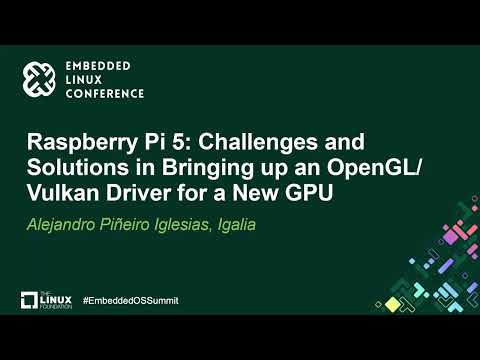
Raspberry Pi 5: Challenges and Solutions in Bringing up an OpenGL/...
summary
Igalia ports Mesa backends to the Raspberry Pi 5 GPU (Broadcom VideoCore) by reusing the V3D/V3D‑based shader compiler, reorganizing the Vulkan driver for multiple hardware generations, and iterating with a simulator-first development approach before real hardware. Work totals about 120 patches merged upstream, includes major shader compiler rewrites and kernel fixes for packet/bitfield differences, and delivers conformant OpenGL ES and Vulkan drivers (Vulkan 1.2 / OpenGL ES 3.x) with ongoing performance tuning.
AI-written summary · about
chapters (15)
- 0:00Raspberry Pi driver intro
- 2:09Mesa driver architecture
- 3:31Raspberry Pi hardware evolution
- 6:23Pi 5 GPU features
- 8:09Driver reorganization
- 10:57Dev workflow and simulator
- 13:23Early Vulkan tests
- 15:28First triangle rendering
- 16:32Progressing to CTS
- 18:37Kernel driver fixes
- 21:27Pi 5 release and upstreaming
- 23:35Current status and future
- 24:19Q&A: Mesa infrastructure
- 26:46Q&A: Broadcom support
- 28:13Q&A: CI testing and farm
related talks
 30mNews from the Embedded GFX Space
 33mGPU Para-Virtualization on Xen
 39mNavigating the Linux Graphics Stack
 58mQt graphics stack: What is new with 3D development with Qt?
 01mWelcome to the Gaming MC!
 18mPreparing for a Valid Performance Evaluation of RISC-V AP, in the Mobile Space
 35mChallenges of using Containers to Run Graphical Embedded Systems
 18mVulkanized: Mobile Game Optimization Techniques