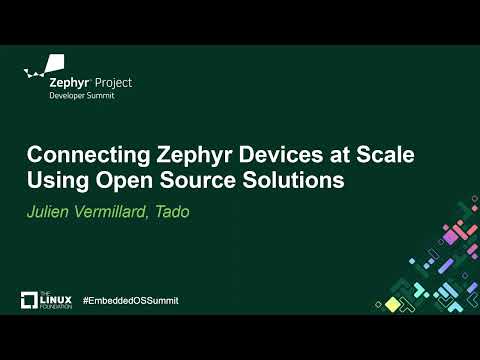
Connecting Zephyr Devices at Scale Using Open Source Solutions
summary
Zephyr devices use built‑in CoAP and LwM2M clients coupled with Eclipse Leshan and Californium (Java) or Go libraries to manage millions of devices; deployments show CoAP combines reliability and application semantics and UDP NAT timeouts force devices to pull updates, not accept pushes. DTLS is recommended for security, blockwise transfer is simple but slow for megabytes, and firmware strategy that sends a URL for the device to download (resumeable) saves battery. Cellular LPWAN (LTE‑M/NB‑IoT) and Matter/Thread require different topologies and tradeoffs.
AI-written summary · about
chapters (12)
- 0:00Connecting Zephyr devices at scale
- 1:08What is CoAP
- 5:34Why CoAP confuses devs
- 8:07CoAP replacing TCP/HTTP
- 11:24Cloud connection challenges
- 16:02CoAP network topologies
- 18:11Lightweight M2M on CoAP
- 21:04Real-world CoAP/LwM2M feedback
- 25:01Firmware updates with CoAP
- 26:49Open source business models
- 28:19Getting started with CoAP
- 31:27Q&A on CoAP comms
related talks
 26mTo Boldly go Where Linux Cannot with Zephyr and Eclipse IoT
 35mEnd-to-end IoT Development with Zephyr
 41mIoT Device Management with Zephyr
 39mZephyr Project: Unlocking IoT Innovation with an Open Source RTOS
 10mLightning Talk: From Ideas to 3 Firmwares Powering Railway-Infrastructure Monitoring...
 50mZephyr Project: An RTOS to Change the Face of IoT
 10mLightning Talk: Open Source Fleet Management in Zephyr
 16mEnhancing your existing and future IoT Devices with Zephyr RTOS