Leveraging virtiofs and vsocket in toro unikernel
summary
Shows how Toro unikernel was extended to support virtio-fs (filesystem passthrough) and virtio-vsock (guest-host socket) so unikernels can avoid implementing network and block drivers and the TCP/IP stack. Compares performance of virtio-fs/vsock vs traditional virtio-net and virtio-blk and quantifies code reduction by porting a web-server that originally used Berkeley sockets.
AI-written summary · about
chapters (10)
- 0:00Intro
- 0:46What are microservices?
- 1:15How are microservices deployed?
- 3:32Application-oriented Kernel
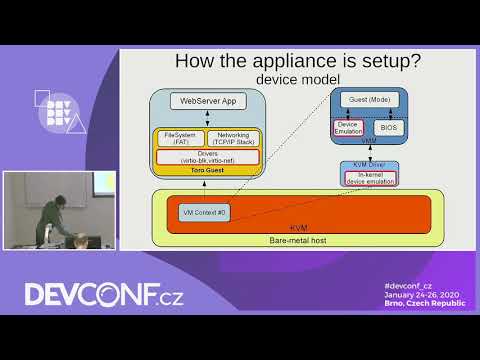
- 6:02How the appliance is setup?
- 6:54ethernet configuration
- 7:20The Static WebServer drawbacks
- 11:58Results
- 14:37Demo
- 17:27Future Work
related talks
 37mHypervisor-less virtio for Real-time and Safety
 45mTrust, confidentiality, and hardening: the virtio lessons
 30mHA-IOV: Applying Hardware-assisted Techniques to IO Virtualization Framework
 07mLightning Talk: Optimizing Security Container Runtime's Network Performance with Modular Plugin TCP/IP Stack
 41mTowards a Cross-Hypervisor Test Framework for VirtIO Backend Validation Using VirtIO...
 33mZephyr‑Based VIRTIO Backend on Xen: Toward Open Source Functional Safety
 34mVirtio-msg: Making Virtio Work Where It Does Not Today
 33mNon-Imperative Network Programming