Implementing Microservices as Kubernetes Operators

summary
Claim: operators act as true microservices for Kubernetes by owning a bounded custom resource, using platform RBAC/HA and API features, and running controllers that reconcile desired state. The demo builds a pod operator with Operator SDK, compiles Go, pushes the image with Podman/Quay and deploys to OpenShift 4.2.13. The operator creates a pod from a PodRequest CR, recreates it when killed, and deletes it when the CR is removed; Prometheus, cloud-credentials and service-CA operators are shown as production examples.
AI-written summary · about
chapters (16)
- 0:00Start
- 5:00How do Resources and Controllers interact?
- 6:47What are Operators?
- 9:49What are Microservices?
- 14:24Monolith Centralized Config Management
- 15:48Microservices: Distributed Config Management
- 18:17Installing & Configuring Software, Without Operators
- 19:02Cluster-monitoring-operator, Operator Value
- 22:10How cloud-credential-operator mints credentials
- 22:55Cloud-credential-operator Credentials Request
- 24:05Service-ca-operator, Without Operators
- 26:47What does the Operator do?
- 27:51How is the Operator created?
- 29:53What are we testing?
- 44:40Distribution Venues
- 46:59What questions can we answer?
related talks
 45mKubernetes Operators: Operating Cloud Native services at scale
 01h 29mTutorial: Deep Dive into the Operator Framework for Kubernetes
 31mKubernetes Operators within Reach of Any Developer
 55mIntroduction to Kubernetes Operators
 29mExtending Kubernetes with Operators
 47mLet's dive into Kubernetes operator creation
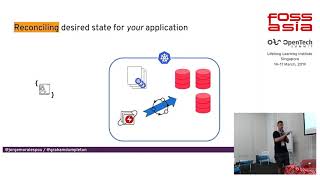 53mAutomating Stateful Applications with Kubernetes Operators
 44mPlatform Engineering: Raise the Level of Abstraction using Kubernetes Operators