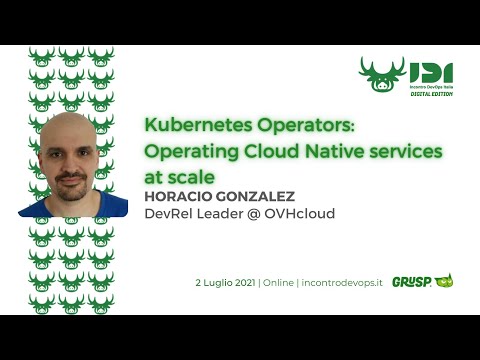
Kubernetes Operators: Operating Cloud Native services at scale
summary
Operators claim to encode routine human ops as CRDs and controllers that reconcile desired and current state. Concrete tooling includes kubebuilder + Operator SDK (Helm or Ansible for simpler cases, Go for full operators). Examples: a Harbor-based private‑registry operator built in Go reuses cert‑management operators and is upstreamed to CNCF and runs in production; a load‑balancer operator uses Multus CNI, HAProxy pods with three interfaces, configMaps and controllers to push configs and gather metrics.
AI-written summary · about
chapters (15)
- 0:00Start
- 6:31What about complex deployments
- 9:31Taming the complexity
- 10:24Helm Charts are configuration
- 13:15A control loop
- 15:29Example: databases
- 17:56Operator Capability Model
- 21:16The Operator Framework
- 22:12Operator Lifecycle Manager
- 24:30Using the platform
- 24:56Working with the community
- 25:29The challenge: reconciliation loop
- 27:37Load Balancer: a critical cog
- 28:03Our legacy Load Balancer stack
- 32:06Config management
related talks
 42mKubernetes Operators: What are They and Why would You Need Them?
 31mKubernetes Operators within Reach of Any Developer
 24mKubernetes Operators with Go
 20mSmooth Operator - A Rough Guide to Kubernetes Operators
 28mSmooth Operator - A Rough Guide to Kubernetes Operators - Olive Power, VMware
 55mIntroduction to Kubernetes Operators
 42mBuild Your Kubernetes Operator with the Right Tool!
 24mAutomating Stateful Apps with Kubernetes Operators